Many agencies focus heavily on closing deals, sending proposals, and securing payments. However, client relationships often begin to weaken immediately after onboarding starts. Delayed communication, fragmented onboarding steps, unclear expectations, and repetitive requests create operational friction that damages trust early in the relationship. As agencies grow, these onboarding failures become harder to manage manually, especially when multiple tools, freelancers, and client projects operate simultaneously.
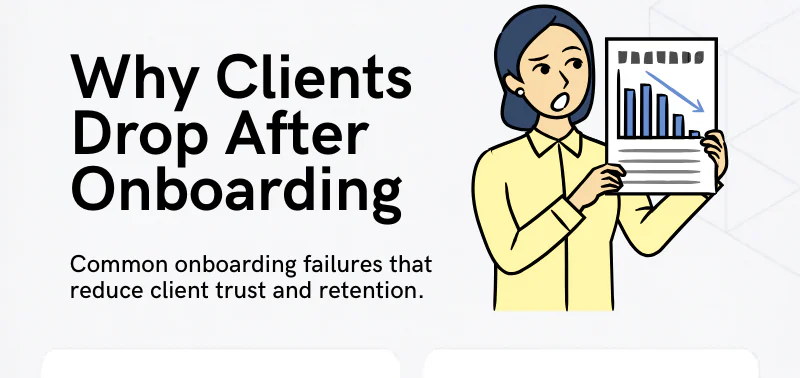
Clients frequently leave after onboarding because agencies create fragmented and inconsistent experiences during the first operational phase. Delayed responses, unclear next steps, missing documents, repetitive forms, and unmanaged expectations reduce confidence quickly. This article explains why onboarding experience failures happen, how AI systems reduce operational friction, and which structural adjustments agencies can implement to improve client retention.
Why Onboarding Experience Determines Client Retention
Many agencies assume onboarding is an administrative stage that simply collects information before project execution begins. In practice, onboarding shapes the client’s first operational impression of the agency. Once confusion appears during this phase, clients begin questioning delivery quality before work even starts.
Most clients do not evaluate agencies only by design quality, technical expertise, or service packages. They evaluate responsiveness, organization, visibility, and process clarity. If clients feel uncertain about timelines, communication channels, deliverables, or responsibilities, they start disengaging emotionally from the partnership.
This explains why agencies sometimes lose clients despite strong technical work. The operational experience surrounding the project becomes harder to trust than the actual service itself.
Agencies already exploring structured onboarding systems can also review How to Automate Client Onboarding Step by Step, which focuses on workflow implementation rather than onboarding failure analysis.
The Real Problem Behind Client Drop Off
Most onboarding failures do not originate from a single mistake. They result from small operational gaps that accumulate during the first days of collaboration. Agencies often underestimate how quickly these gaps affect confidence.
For example, a client signs a contract and expects immediate direction. Instead, they receive scattered emails, unclear instructions, several unrelated forms, and delayed answers. Team members may request the same information twice because systems are disconnected. Meanwhile, the client still does not understand what happens next.
From the agency perspective, these issues may appear minor. From the client perspective, they suggest operational instability.
At this stage, trust weakens because onboarding represents the first proof that the agency can manage larger responsibilities later in the project.
Operational Failures That Cause Clients to Leave
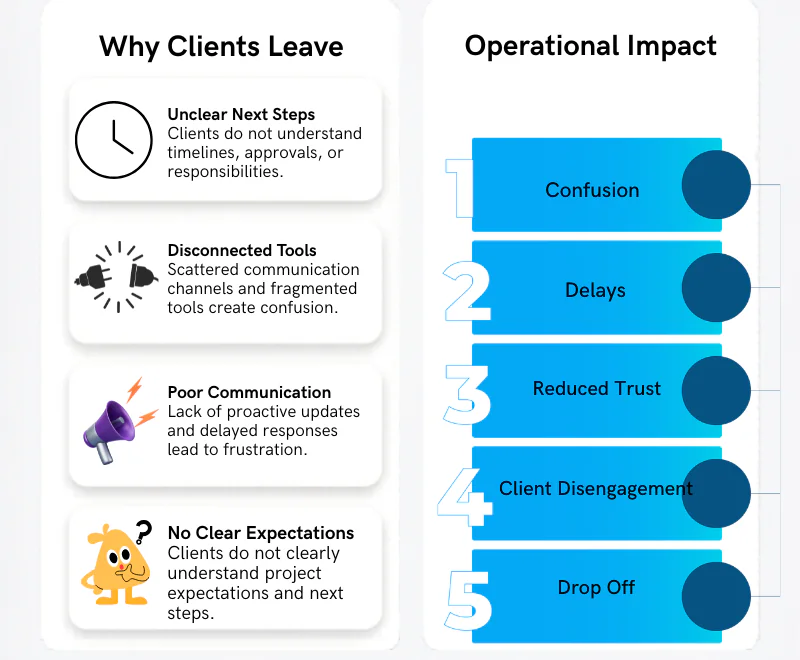
Unclear Next Steps
Clients often leave onboarding confused about timelines, deliverables, or responsibilities. Agencies may internally understand their own process, yet clients experience the process differently because they lack operational context.
For example, agencies frequently assume clients understand when content submissions, approvals, meetings, or revisions should happen. However, without structured onboarding communication, clients remain uncertain about what they must prepare and when.
This confusion creates avoidable delays. Delays then create frustration because clients feel the project lacks momentum.
Too Many Manual Requests
Many onboarding systems rely on repetitive manual communication. Agencies request files through email, follow up manually for missing assets, and repeatedly ask for approvals across multiple channels.
As project volume increases, this process becomes inconsistent. Some clients receive fast responses while others wait days for updates.
Once onboarding becomes dependent on individual memory instead of systems, operational reliability decreases significantly.
Agencies facing this issue often benefit from structured intake workflows such as those explained in Client Intake System AI Forms.
Disconnected Tools and Communication Channels
Agencies commonly use multiple tools during onboarding, including forms, CRMs, project management systems, cloud storage platforms, scheduling software, and email platforms. Problems emerge when these systems do not communicate properly.
A client may submit onboarding details through a form, but the project manager still requests the same information later because internal systems failed to synchronize.
Similarly, onboarding documents may exist inside email threads while approvals happen through messaging apps and task tracking happens elsewhere.
This fragmented experience creates operational fatigue for clients because they must continuously adapt to the agency’s internal structure.
Slow Response Times During Early Communication
Clients expect fast responses immediately after payment or contract approval. During onboarding, responsiveness directly influences perceived professionalism.
If agencies take too long to answer simple questions, clients begin assuming larger communication problems will happen later during delivery.
This issue becomes more severe when agencies onboard multiple clients simultaneously without automation support. Manual follow ups create bottlenecks, especially during weekends, holidays, or peak workload periods.
Agencies struggling with delayed communication workflows may also benefit from reviewing Slow Response Time Lead Loss AI Small Business, which examines how communication delays affect trust and conversion.
Why Agencies Often Misdiagnose the Problem
Many agencies assume client churn happens because of pricing, competition, or unrealistic expectations. While those factors can contribute, onboarding failures frequently create the first major rupture in the relationship.
Agencies sometimes focus on improving service packages while ignoring the operational experience surrounding the service itself.
For example, agencies may invest heavily in branding, portfolio design, and sales processes while onboarding still relies on scattered spreadsheets and manual email threads.
As a result, the client journey becomes inconsistent. The sales experience feels organized while onboarding feels chaotic.
This transition damages trust because clients expect operational continuity after purchase.
How AI Changes the Onboarding Experience
AI changes onboarding by reducing operational friction across communication, organization, and process management. Instead of relying entirely on manual coordination, agencies can create structured systems that maintain consistency at scale.
AI does not replace human interaction during onboarding. Instead, it strengthens process reliability by handling repetitive coordination tasks automatically.
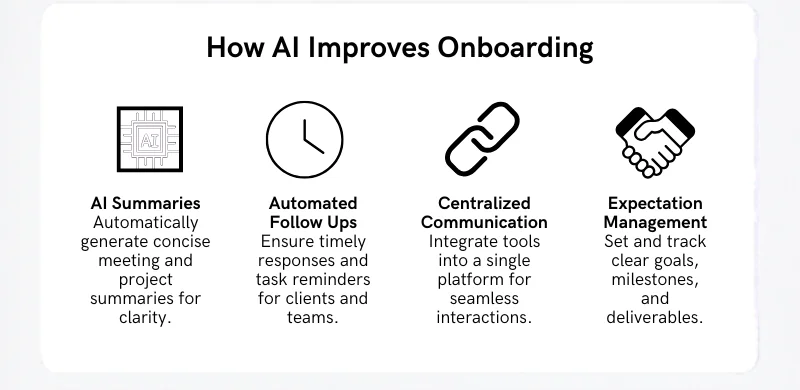
For example, AI systems can summarize client intake forms into project briefs, generate onboarding emails automatically, detect missing information, organize uploaded assets, and trigger reminders when deadlines are approaching.
These automations reduce delays while improving visibility for both agency teams and clients.
Centralized Client Information
AI onboarding systems reduce duplication by centralizing project data. Once clients submit onboarding information, systems can automatically distribute relevant details across project management tools, CRM platforms, communication systems, and shared documentation.
This prevents agencies from repeatedly requesting the same information.
As a result, clients experience smoother onboarding with fewer interruptions.
Automated Communication Flow
Many onboarding failures happen because agencies forget follow ups or communicate inconsistently between projects.
AI workflows solve this by creating predefined communication sequences triggered by client activity.
For example, once a contract is signed, the system can automatically:
- Send onboarding instructions.
- Provide scheduling links.
- Request project assets.
- Create internal tasks.
- Notify team members.
- Send reminders for incomplete submissions.
These workflows create predictable onboarding experiences without requiring constant manual oversight.
Agencies exploring onboarding communication automation can also review AI Prompts for Onboarding Emails and Client Data.
Expectation Management Through AI Systems
One major reason clients disengage after onboarding involves mismatched expectations. Clients often expect immediate delivery while agencies expect preparation phases, approvals, or asset collection first.
AI onboarding systems help reduce this disconnect by standardizing communication around timelines and project phases.
For example, onboarding workflows can automatically explain:
- What happens next.
- Which materials are required.
- When approvals are expected.
- How communication works.
- Which delays may affect timelines.
This clarity reduces uncertainty early in the relationship.
Agencies focusing specifically on operational expectation management should also read AI Workflow Managing Client Expectations.
The Most Common Signs of a Weak Onboarding Experience
Clients Stop Responding Early
One of the earliest indicators appears when clients begin delaying replies shortly after onboarding begins. In many cases, this does not happen because clients lost interest in the project itself. It happens because the onboarding process already feels exhausting.
Clients may postpone form completion, ignore requests, or delay approvals because the process lacks clarity or structure.
Repeated Clarification Questions
If clients repeatedly ask what happens next, where to upload files, or who handles approvals, onboarding communication lacks operational clarity.
These questions reveal structural gaps rather than client confusion.
Strong onboarding systems reduce dependency on repeated explanations because information flows consistently through automated guidance.
Internal Team Misalignment
Weak onboarding also affects internal operations. Team members may lack access to updated client information, resulting in duplicated work and inconsistent communication.
For example, designers may request branding assets already submitted earlier, while project managers may lack visibility into onboarding completion status.
This internal fragmentation eventually becomes visible to clients.
Why Manual Onboarding Fails as Agencies Scale
Manual onboarding processes sometimes work during early business stages because client volume remains manageable. However, growth increases operational complexity rapidly.
As agencies onboard more clients, communication threads multiply across tools and team members. Project managers spend more time coordinating onboarding than managing project execution itself.
Without structured systems, agencies eventually face:
- Delayed onboarding.
- Missed follow ups.
- Incomplete client data.
- Communication inconsistencies.
- Increased churn risk.
At this stage, operational reliability becomes impossible to maintain manually.
How AI Reduces Client Anxiety During Onboarding
Clients often feel uncertain after purchasing services because they cannot see internal agency operations. They judge reliability through communication patterns and process visibility.
AI systems reduce this anxiety by creating continuous operational feedback.
For example, automated onboarding systems can confirm:
- Document receipt.
- Form completion status.
- Upcoming meetings.
- Pending approvals.
- Project milestones.
These updates reassure clients that progress continues even before delivery work becomes visible.
As a result, onboarding feels organized rather than reactive.
The Strategic Shift Agencies Need
Agencies often treat onboarding as an administrative phase attached to project delivery. However, onboarding itself has become part of the service experience.
Clients increasingly expect operational transparency, fast communication, and structured collaboration from the beginning.
This means agencies must redesign onboarding around client experience rather than internal convenience.
AI systems support this shift because they create repeatable operational standards without increasing manual workload.
Instead of depending entirely on individual coordination, agencies can build structured onboarding environments that scale consistently across projects.
Example of an AI Supported Onboarding Flow
A client signs a proposal through the agency’s sales system. Once payment confirmation arrives, the onboarding workflow activates automatically.
The client immediately receives:
- A welcome email.
- An onboarding form.
- A scheduling link.
- A document upload portal.
- A project timeline overview.
As the client submits information, AI summarizes project goals and distributes key details into the agency’s project management platform.
If required files remain missing after 48 hours, the system sends reminders automatically.
Meanwhile, internal teams receive onboarding updates without requiring manual coordination.
This process creates consistency while reducing communication delays and onboarding confusion.
How Agencies Can Improve Onboarding Without Rebuilding Everything
Agencies do not need complex enterprise systems to improve onboarding experience. Most improvements come from reducing friction inside existing workflows.
In practice, agencies often improve onboarding significantly by:
- Centralizing communication.
- Automating repetitive follow ups.
- Standardizing onboarding steps.
- Creating clearer expectations.
- Reducing manual coordination.
Even simple AI workflows can improve operational consistency dramatically when implemented around real onboarding bottlenecks.
FAQ
Why do clients leave after onboarding?
Clients often leave because onboarding creates confusion, delays, fragmented communication, or unclear expectations. These operational failures reduce trust early in the relationship before project delivery fully begins.
How does AI improve client onboarding?
AI improves onboarding by automating repetitive tasks, organizing client information, standardizing communication, and reducing delays across onboarding workflows.
What is the biggest onboarding mistake agencies make?
The biggest mistake involves treating onboarding as administrative work instead of part of the client experience. Poor onboarding communication often damages trust faster than technical delivery problems.
Can small agencies automate onboarding?
Yes. Small agencies can automate onboarding using forms, workflow automation tools, scheduling systems, AI summaries, and automated follow up sequences without requiring enterprise infrastructure.
Which onboarding tasks benefit most from automation?
Client intake, document collection, onboarding emails, reminders, scheduling, project brief generation, and approval tracking are among the onboarding tasks that benefit most from automation.
What This Article Does Not Cover
This article focuses on onboarding experience failures that cause client drop off after project initiation. It examines operational friction, communication breakdowns, and onboarding structure problems.
It does not focus on technical workflow implementation, advanced automation architecture, or detailed onboarding software comparisons. Agencies seeking implementation tutorials or onboarding tool ecosystems should explore related UsefulAIHub resources covering those specific operational layers.
Operationally strong onboarding experiences reduce confusion before larger project challenges appear. Agencies that improve onboarding structure often improve retention, communication quality, and client confidence simultaneously because the first operational impression becomes more consistent across every project lifecycle.